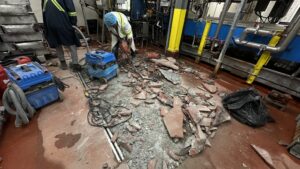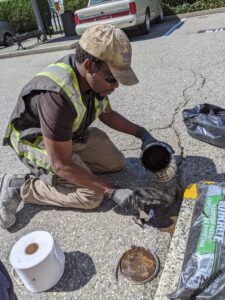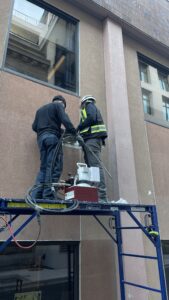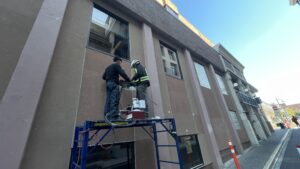
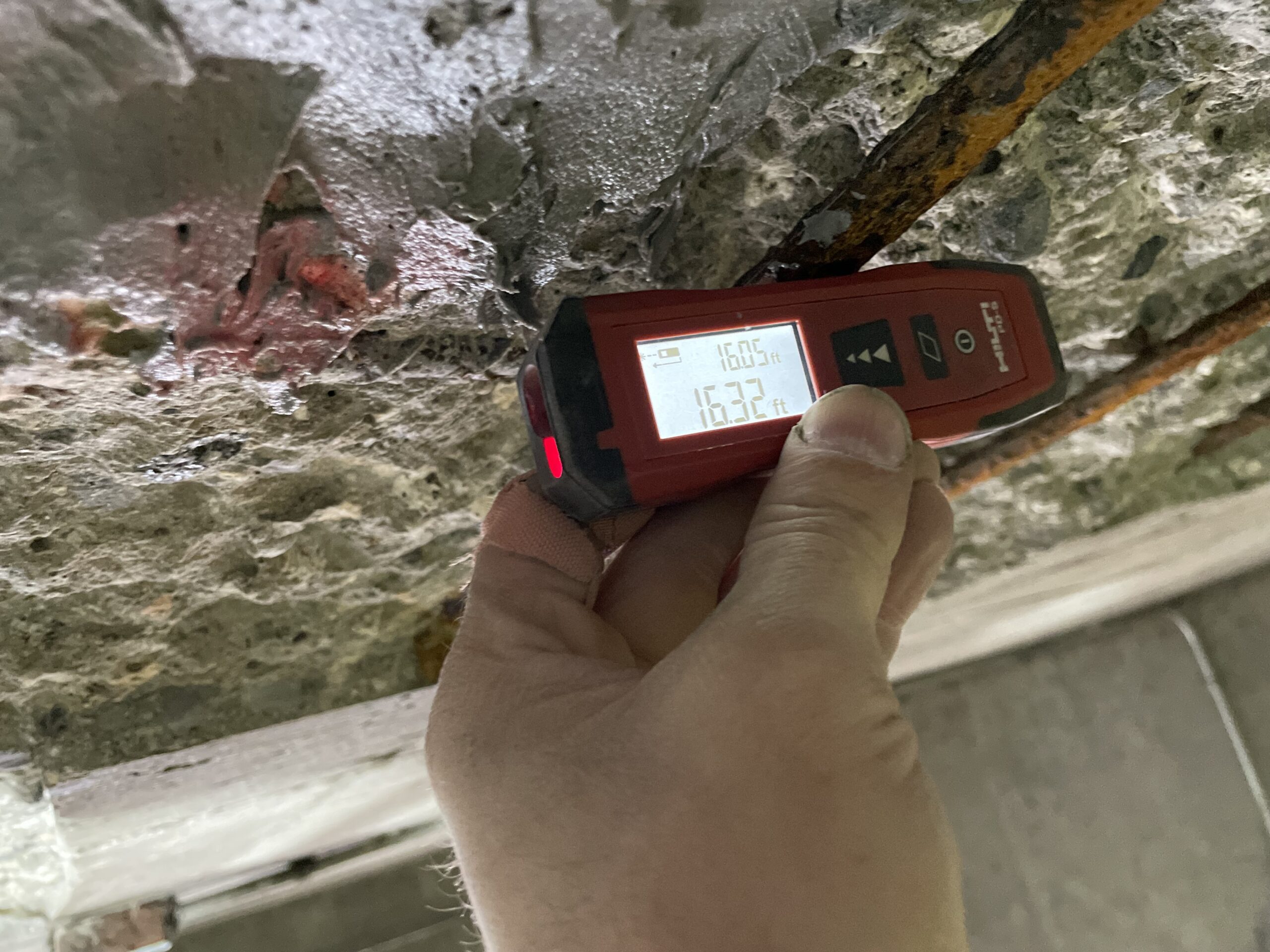
Working in or around post-tension concrete structures requires specific safety awareness and precautions that go beyond standard concrete repair practices. The energy stored in a tensioned post-tension cable is substantial — a single tendon tensioned to full design force contains enough stored energy to cause serious injury or death if suddenly released. Every contractor, engineer, and property manager involved in repair work in a post-tension building needs to understand these risks and the protocols required to manage them.
Understanding the Hazard
A standard 15.2mm monostrand tendon in a Metro Vancouver building is typically stressed to approximately 140–160 kN (31,000–36,000 lbs) of tension. If this tendon is inadvertently cut — by a saw blade, core drill, or demolition tool — the stored energy releases instantaneously. The severed cable ends can move with great force and velocity. The slab edge anchor pocket can explode as the anchor releases. Concrete fragments can be projected over a significant area. The result is a life-safety incident with potential for fatalities.
This is not a theoretical risk — incidents involving inadvertent PT tendon cutting do occur on construction sites, and they are almost always the result of inadequate investigation of tendon locations before cutting work begins. Our post-tension repair team maintains a strict zero-tolerance policy for cutting into slabs without prior tendon location survey.
Tendon Location Survey: The Non-Negotiable First Step
Before any saw cutting, core drilling, demolition, or anchoring into a suspected post-tension slab, a tendon location survey must be completed. The standard method is ground-penetrating radar (GPR) scanning, which can locate tendons with sufficient precision for safe layout of cutting and drilling patterns. GPR survey results must be clearly marked on the slab surface and reviewed by the contractor and structural engineer before any work proceeds.
In addition to horizontal tendon location, the survey must establish the tendon depth profile — tendons in PT slabs follow parabolic profiles (high at supports, low at mid-span) that mean the same tendon can be at very different depths depending on where you are cutting. Cutting at a location where the GPR shows no tendon but not accounting for the depth profile can still result in a tendon strike.
Safety Zones and Work Procedures
During any work near post-tension tendons, safety zones must be established that keep personnel clear of the danger areas in the event of a tendon release — typically behind the direction of tendon travel (toward anchor ends) and in line with the anchor pocket projection. All workers in the area must be briefed on PT hazards and the location of tendons relative to the work area. See our concrete repair services for safe repair practices in PT structures and our FAQ for more on PT safety requirements in Metro Vancouver.
Contact Miyagi Construction for a free site assessment at estimate@miyagiconstruction.com or call (778) 513-7471.
Additional Resources
For more information on concrete standards and construction safety in British Columbia, visit National Research Council Canada and the CSA Group for industry standards and guidelines.
Get a Free On-Site Assessment
Tell us about your project and we'll get back to you within 24 hours. No obligation, no pressure.