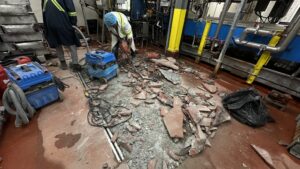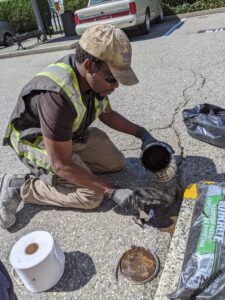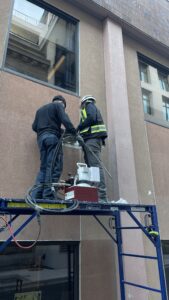
For strata councils managing multi-unit residential buildings in Vancouver, the underground parkade is often the most expensive and complex maintenance challenge you will face. Parkade decks are simultaneously structural elements and waterproof membranes — they support vehicle traffic above while protecting occupied space below. When the waterproofing fails, the consequences cascade quickly: water infiltration damages concrete, corrodes reinforcing steel, creates hazardous conditions, and triggers repair costs that can run into hundreds of thousands of dollars. Understanding how parkade waterproofing systems work — and when they need attention — is one of the most valuable things a strata council can do to protect the building’s long-term value.
Why Parkades Leak
Parkade waterproofing failure is almost never a single-point failure. It is usually the result of multiple factors working together over time.
Age and Membrane Degradation
Most traffic-bearing waterproofing membranes have a service life of 10 to 20 years depending on the system type, installation quality, and traffic load. As membranes age, they become brittle, lose elasticity, and develop micro-cracks that allow water to pass through. If your building is more than 15 years old and the waterproofing has not been replaced, it is likely at or past its useful life.
Expansion Joint Failures
Expansion joints allow the structure to move with temperature changes and settling. The sealants and compression seals used at these joints are often the first point of failure — they are subjected to vehicle traffic, thermal movement, and exposure to water and chemicals. A failed expansion joint can allow significant water infiltration even if the surrounding membrane is intact.
Drainage Problems
Parkade decks are designed to drain quickly. When drains are blocked by debris, or when the slope of the deck has settled or was improperly designed, water pools on the surface and increases hydrostatic pressure on the membrane. Standing water dramatically shortens membrane life.
Deicing Salt Damage
Chloride ions from deicing salts penetrate concrete and membranes, accelerate rebar corrosion, and chemically degrade some membrane types over time. Parkades with a history of deicing salt use require more frequent inspection and earlier membrane replacement.
Types of Waterproofing Membranes
Hot-Applied Rubberized Asphalt
One of the most durable systems for vehicular parkades. Applied as a hot liquid and topped with a protection board and traffic coating, rubberized asphalt membranes conform to the substrate, self-heal minor punctures, and provide excellent waterproofing performance. Service life of 20+ years with proper installation. Best for new construction or full membrane replacement projects.
Cold-Applied Liquid Membranes
Applied as a liquid that cures to form a seamless elastomeric membrane. Well-suited for complex geometries, drains, and penetrations — generally more flexible than sheet membranes. Practical for phased renovation projects. Quality varies significantly by product and installer skill.
Sheet Membranes
Bituminous sheet membranes are applied either with a torch or as peel-and-stick systems. Cost-effective for lower-traffic areas or as an overlay on relatively flat decks. Laps and seams require careful attention during installation as these are common points of failure.
Traffic Coatings
Traffic coatings are applied over the waterproofing membrane and serve as the wearing surface — the layer that contacts tires and foot traffic. They must be durable, slip-resistant, and UV-stable. Common types include polyurethane traffic coatings (most common in Vancouver), methyl methacrylate systems for faster cure times, and epoxy coatings for pedestrian or low-traffic areas. Traffic coatings typically need recoating every 5 to 10 years even when the underlying membrane is still in good condition.
Drainage Design and Maintenance
Even the best membrane will not perform properly without a functional drainage system. Parkade drains should be inspected and cleaned at least twice a year — more frequently if there is nearby construction or landscaping generating debris. The deck slope toward drains should be verified periodically, as structural settlement can create reverse slopes that allow water to pool. Perimeter drains at the base of ramps, pit drains at low points, and scuppers should all be part of your regular maintenance checklist.
Maintenance Schedules for Vancouver Parkades
A proactive maintenance schedule significantly extends the life of your waterproofing system and reduces lifetime costs. We recommend the following for strata councils in the Lower Mainland:
- Semi-annually: Clean all drains and scuppers; inspect expansion joints for cracking or separation; wash the deck surface to remove deicing salt residue
- Annually: Visual inspection of the traffic coating for wear, cracking, or delamination; check for water staining on the underside of the parkade deck
- Every 3–5 years: Professional condition assessment including hammer-sounding survey and joint inspection; recoat traffic surface if worn
- Every 10–15 years: Full waterproofing system assessment with core sampling; plan for membrane replacement if system is approaching end of service life
BC Building Code Considerations
The BC Building Code requires that waterproofing systems in parkades meet specific performance standards related to water penetration resistance, drainage, and slip resistance. For strata councils, this matters particularly when undertaking significant repairs or replacements — work must comply with current code requirements, which may be more stringent than what was in place when the building was constructed. WorkSafeBC also has requirements for slip resistance on walking surfaces in parkades. Traffic coatings must maintain adequate anti-slip properties, particularly in areas used by pedestrians as well as vehicles. We recommend that strata councils obtain a formal engineering assessment from a qualified structural or waterproofing engineer before undertaking any significant parkade restoration.
Ready to Protect Your Property?
Miyagi Construction Ltd. has been serving property managers, strata councils, and commercial building owners across the Vancouver Lower Mainland for years. Whether you’re dealing with urgent structural concerns or planning proactive maintenance, our team provides honest assessments, quality workmanship, and lasting results.
Contact us today for a free on-site estimate:
📞 778-513-7471
✉️ estimate@miyagiconstruction.com
We serve Burnaby, Vancouver, Surrey, Richmond, Coquitlam, New Westminster, and the entire Lower Mainland.
Related Services: Learn more about our parkade resurfacing and waterproofing services, concrete repair — or contact us at estimate@miyagiconstruction.com to request a free site assessment.
Additional Resources
For more information on concrete standards and construction safety in British Columbia, visit BC Housing and the WorkSafeBC for industry standards and guidelines.
Get a Free On-Site Assessment
Tell us about your project and we'll get back to you within 24 hours. No obligation, no pressure.