If you manage a strata building, commercial property, or parkade in Vancouver, concrete spalling is one of those problems you absolutely cannot ignore. What starts as a few flaking chips on the surface can quickly develop into deep structural damage — and the repair bill grows fast once that happens. The good news is that spalling gives you warning signs well before it becomes critical. Learning to recognize them early can save your strata thousands of dollars.
What Is Concrete Spalling?
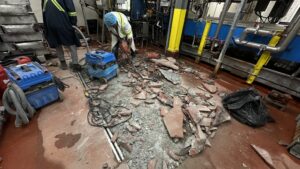
Spalling refers to the flaking, chipping, or breaking away of the surface layer of concrete. It typically begins as a cosmetic issue — small fragments peeling off or shallow craters forming on a surface — but it almost always signals something happening beneath the surface. When left untreated, spalling can expose the reinforcing steel (rebar) inside the concrete to moisture and air, triggering a cycle of corrosion that accelerates structural deterioration. In Vancouver’s Lower Mainland, spalling is especially common because of the region’s wet climate, freeze-thaw conditions in winter months, and the widespread use of deicing salts in parkades and on walkways.
What Does Concrete Spalling Look Like?
Early-Stage Spalling
- Surface scaling: A thin, dusty layer of concrete flaking off — the surface looks rough or pitted.
- Pop-outs: Small conical holes where aggregate particles have popped out, often caused by moisture freezing inside the concrete.
- Hairline cracks: Fine cracks on the surface without significant depth — may be shrinkage cracks or early indicators of stress.
Moderate-Stage Spalling
- Exposed aggregate: The smooth paste surface has worn away and gravel or crushed stone is visible inside.
- Delamination: Sections of concrete separated from the layer beneath. Tap on the surface — a hollow sound confirms delamination.
- Rust staining: Brown or orange streaks on the surface. This is a critical sign — it means embedded rebar is already corroding.
Late-Stage Spalling
- Exposed rebar: Steel reinforcement visible through broken concrete. Structural integrity is compromised.
- Large chunks breaking away: Entire sections falling off overhead elements like parkade ceilings or balcony soffits.
- Active corrosion with cracking: Rust expands as it forms, cracking the concrete from within — called corrosion-induced spalling.
What Causes Concrete Spalling in Vancouver?
Freeze-Thaw Cycles
Even Vancouver experiences freeze-thaw cycles — particularly at higher elevations or during cold snaps. Water infiltrates pores and cracks in the concrete, freezes, expands by about 9%, and puts enormous pressure on the surrounding material. Repeated cycles eventually break the surface apart. Parkade ramps, outdoor staircases, and exposed balconies are especially vulnerable.
Rebar Corrosion
Steel reinforcement naturally rusts when exposed to oxygen and moisture. When rebar corrodes, it swells — sometimes up to four times its original volume — and the expanding steel literally breaks apart the concrete around it. This is called corrosion-induced spalling and is one of the most destructive forms of concrete deterioration, common in older buildings where inadequate concrete cover was poured over the rebar.
Deicing Salts
Sodium chloride and other deicing compounds are widely used in Vancouver parkades during winter. These salts are extremely aggressive toward concrete — they lower the freezing point of water (increasing freeze-thaw cycles), penetrate the concrete matrix, and accelerate corrosion of embedded steel. If your parkade has a history of deicing salt use and has not received protective coatings, spalling is likely already underway.
Carbonation
Over time, carbon dioxide from the atmosphere reacts with calcium hydroxide in concrete, gradually neutralizing the alkaline environment that protects embedded steel. Once carbonation reaches rebar depth, corrosion begins. In older buildings, this is a significant contributor to spalling.
Early vs. Late Stage: Why Timing Matters
Early-stage spalling is almost always cheaper and faster to repair. A fresh application of cementitious repair mortar combined with appropriate surface sealing can halt the problem at relatively low cost. Preventive coatings applied before spalling occurs can defer repairs by a decade or more. Late-stage spalling requires full concrete removal and replacement, rebar treatment, structural assessment, and potentially temporary shoring — the cost difference between early and late intervention can easily be 5x to 10x.
When Should You Call a Professional?
Call a concrete repair specialist as soon as you notice any rust staining on exterior concrete surfaces, hollow-sounding areas when tapping with a hammer, visible rebar or delamination on structural elements, spalling on overhead surfaces such as parkade ceilings or balcony soffits, or cracks wider than 0.3mm on structural members. A qualified contractor will conduct a condition assessment that may include a hammer-sounding survey, core sampling, or carbonation depth testing — giving you a repair scope that addresses the underlying cause, not just the visible damage.
Ready to Protect Your Property?
Miyagi Construction Ltd. has been serving property managers, strata councils, and commercial building owners across the Vancouver Lower Mainland for years. Whether you’re dealing with urgent structural concerns or planning proactive maintenance, our team provides honest assessments, quality workmanship, and lasting results.
Contact us today for a free on-site estimate:
📞 778-513-7471
✉️ estimate@miyagiconstruction.com
We serve Burnaby, Vancouver, Surrey, Richmond, Coquitlam, New Westminster, and the entire Lower Mainland.
Related Services: Learn more about our professional concrete repair, parkade waterproofing and resurfacing — or contact us at estimate@miyagiconstruction.com to request a free site assessment.
Additional Resources
For more information on concrete standards and construction safety in British Columbia, visit BC Construction Safety Alliance and the CSA Group for industry standards and guidelines.
Get a Free On-Site Assessment
Tell us about your project and we'll get back to you within 24 hours. No obligation, no pressure.