Built-in planters and planter boxes are a common feature in Vancouver strata buildings — often included by developers as an aesthetic enhancement to balconies and rooftop decks. They are also one of the most reliable causes of premature balcony waterproofing failure and subsequent concrete deterioration. Understanding why planters cause water damage — and how to address the problem when it has occurred — is important for strata councils managing buildings with this design feature.
Why Built-In Planters Are a Waterproofing Problem
The fundamental issue with planters on balconies is that they create a continuous-moisture environment in direct contact with the waterproofing membrane. Plants require regular watering, and the soil in a planter retains moisture for extended periods. This means the waterproofing membrane beneath the planter is under constant hydrostatic pressure and never has the opportunity to dry out — conditions that dramatically accelerate membrane deterioration compared to areas exposed to alternating wet-dry cycles.
The soil itself creates additional problems. Plant roots seek moisture and can penetrate membrane seams or small cracks, physically disrupting the waterproofing continuity. Organic acids in the soil can attack certain membrane materials. The weight of wet soil can create differential loading that stresses the concrete substrate and the membrane at loading transitions.
Consequences of Planter-Related Waterproofing Failure
When the waterproofing beneath a planter fails, the concrete slab is exposed to continuous moisture from above. In Metro Vancouver’s climate, this means the concrete below a failed planter may be saturated year-round — creating optimal conditions for carbonation-induced and chloride-induced rebar corrosion. The rebar corrosion that results from years of planter-related waterproofing failure typically produces spalling on the soffit of the unit below, which is when the problem is usually first noticed — years after it began. Our concrete repair team regularly addresses spalling resulting from planter-related moisture infiltration.
Repairing Planter-Related Water Damage
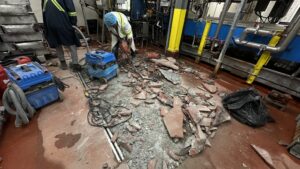
Addressing planter-related balcony water damage requires removing the planter, excavating the soil and drainage material, demolishing the planter walls (if they are themselves sources of water infiltration), repairing any concrete structural damage, and installing a completely new waterproofing system beneath and around the planter footprint. If planters are to be rebuilt, they should incorporate a properly designed drainage layer, drainage board, and root barrier in addition to the primary waterproofing membrane.
For strata corporations managing multiple planters with potential water damage, a phased approach — assessing all planter conditions and prioritizing the most compromised — allows the repair program to be managed within annual maintenance budgets. See our waterproofing restoration services and our FAQ for guidance on planter waterproofing repair in Vancouver strata buildings.
Contact Miyagi Construction for a free site assessment at estimate@miyagiconstruction.com or call (778) 513-7471.
Additional Resources
For more information on concrete standards and construction safety in British Columbia, visit BC Construction Safety Alliance and the CSA Group for industry standards and guidelines.
Get a Free On-Site Assessment
Tell us about your project and we'll get back to you within 24 hours. No obligation, no pressure.