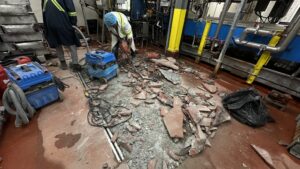

Manufacturing facilities place some of the most demanding requirements on concrete floors of any building type — heavy machinery, loaded forklifts, impact loading from press operations, chemical exposure from lubricants and process fluids, and continuous high-cycle traffic all accelerate floor deterioration. When manufacturing floors reach the point where deterioration affects operations, safety, or facility maintenance, industrial floor resurfacing provides a cost-effective path to restoration without the disruption of full slab replacement.
When Resurfacing Is the Right Choice
Industrial floor resurfacing is appropriate when the existing concrete slab is structurally sound but the surface has deteriorated beyond the point where it can be adequately maintained. Typical surface conditions that warrant resurfacing include: significant scaling or delamination of the surface zone (top 3–10mm) due to freeze-thaw damage, chemical attack, or abrasion; widespread joint deterioration that has progressed to edge breakdown affecting forklift operations; surface contamination (oil, chemical, or residue penetration) that cannot be adequately removed for cleaning or recoating; and loss of floor flatness or surface hardness that is reducing operational efficiency.
Resurfacing is not appropriate when the underlying slab has significant structural cracks, excessive differential settlement, or inadequate load capacity. In these cases, the structural problems must be addressed — either through repair or partial slab replacement — before resurfacing is applied. Our concrete repair team assesses structural slab conditions before specifying resurfacing systems.
Industrial Overlay Systems for Manufacturing Floors
The most common resurfacing approaches for manufacturing facilities include: thin-set epoxy overlays (1–3mm) providing a new hard, chemical-resistant surface over sound concrete; cementitious underlayment overlays (5–25mm) for leveling or rebuilding surface profiles; and polyurethane cement systems providing chemical resistance and flexibility for facilities with aggressive chemical exposure or thermal cycling.
The selection of the appropriate overlay system depends on the specific loading, chemical exposure, thermal requirements, and operational constraints of each facility. Surface preparation — always the critical foundation for any overlay system — must be matched to the overlay type and the condition of the existing concrete.
Minimizing Production Disruption During Resurfacing
Manufacturing floor resurfacing in operational facilities requires detailed planning to minimize production impacts. Our team develops phased resurfacing plans that work in sections, allowing production to continue in unaffected areas. Fast-cure systems can accelerate return-to-service times — some high-performance polyurethane systems achieve light pedestrian traffic in 6–8 hours, with heavy forklift loads within 24 hours. See our industrial floor coating services and our FAQ for guidance on manufacturing floor resurfacing projects.
Contact Miyagi Construction for a free site assessment at estimate@miyagiconstruction.com or call (778) 513-7471.
Additional Resources
For more information on concrete standards and construction safety in British Columbia, visit CSA Group and the WorkSafeBC for industry standards and guidelines.
Get a Free On-Site Assessment
Tell us about your project and we'll get back to you within 24 hours. No obligation, no pressure.