Retail plazas and strip malls in Metro Vancouver have concrete infrastructure that is constantly exposed to the combined stresses of vehicle traffic, deicing materials, thermal cycling, and the cumulative impact of thousands of daily pedestrian crossings. As these properties age, concrete deterioration in parking lots, sidewalks, loading areas, and structural elements becomes a maintenance priority that affects both appearance and liability.
Common Concrete Repair Needs in Retail Plazas
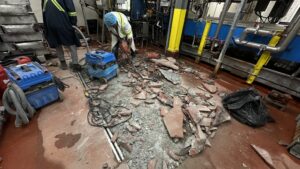
Parking lot concrete in retail plazas deteriorates through joint failure, surface scaling, and edge spalling. Control joints and expansion joints are the first areas to show significant deterioration — as the joint filler ages and hardens, it loses its ability to accommodate slab movement, and the joint edges begin to chip and break under vehicle loading. Once joint edges deteriorate, water infiltrates and accelerates further deterioration through the freeze-thaw cycle.
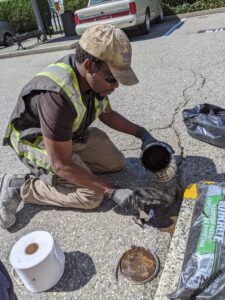
Sidewalk and pedestrian access areas in retail plazas develop trip hazards through differential settlement — typically at control joints or at transitions from asphalt to concrete — that create ADA compliance and liability concerns. Surface scaling on concrete that was deiced with calcium chloride or sodium chloride is also common, producing a rough, deteriorated surface that is difficult to clean and unattractive to retail tenants and customers. Our concrete repair services address all of these conditions.
Structural Concrete Repair in Strip Mall Buildings
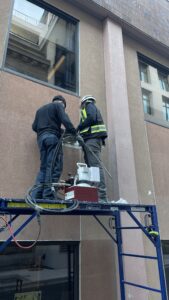
Older strip mall buildings with concrete column structures, concrete canopy beams, or concrete building facades often require structural concrete repair as part of building maintenance. Concrete spalling on column bases and beam soffits, caused by rebar corrosion driven by water infiltration through failed coatings or caulking, creates safety and liability concerns that property owners must address proactively.
Column base repairs in retail plazas are particularly common because the columns are subject to impact from vehicles in parking areas, deicing salt splash, and drainage water from roof downspouts — all of which accelerate concrete deterioration at the most vulnerable point of the column. Temporary barricades may be needed during repair to protect the work area from ongoing vehicle traffic.
Minimizing Disruption to Retail Tenants During Repairs
Concrete repair in an operating retail plaza requires careful coordination with tenant operations, delivery schedules, and customer access requirements. Our team develops work plans that maintain safe pedestrian and vehicle access to retail premises throughout construction, and communicates clearly with property management about scheduling, access restrictions, and expected completion timelines. See our waterproofing services for canopy and deck applications, and our FAQ for more on retail plaza concrete repair planning.
Contact Miyagi Construction for a free site assessment at estimate@miyagiconstruction.com or call (778) 513-7471.
Additional Resources
For more information on concrete standards and construction safety in British Columbia, visit BC Construction Safety Alliance and the CSA Group for industry standards and guidelines.
Get a Free On-Site Assessment
Tell us about your project and we'll get back to you within 24 hours. No obligation, no pressure.