Concrete honeycombing is a construction defect that appears as a rough, porous, void-filled texture in a hardened concrete surface — resembling the irregular open cells of a honeycomb. It occurs when aggregate particles are not properly surrounded by cement paste and mortar, leaving voids in the concrete matrix. Understanding the causes, severity assessment, and repair options for honeycombing is important for building owners dealing with this relatively common defect.
What Causes Concrete Honeycombing?
Honeycombing typically results from one or more of the following during the original concrete pour: inadequate concrete consolidation (failure to properly vibrate the concrete to eliminate trapped air and allow the mix to fully fill the formwork); concrete mix design issues such as overly stiff mixes (low slump), gap-graded aggregate, or excessive aggregate size relative to the formwork and rebar spacing; reinforcement congestion that physically prevents concrete from flowing around dense rebar layouts; and improper form vibration or formwork gaps that allow aggregate to bridge across the form without being filled with paste.
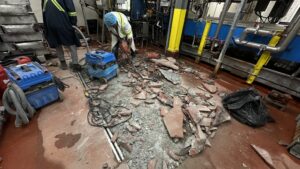
In parkades and structural concrete elements, honeycombing is most often discovered when formwork is stripped, at the base of columns and walls where concrete tends to be least well-consolidated, and on the undersides of slabs where consolidation is most difficult. Our concrete repair team regularly addresses honeycombing found during parkade restoration projects.
Assessing the Severity of Honeycombing
Not all honeycombing is equally serious. Shallow surface honeycombing — affecting only the outer 20–30mm of a non-structural surface element — may be primarily a cosmetic concern. Deep honeycombing that extends through the concrete cover to expose or nearly expose reinforcing steel is a significant durability concern, as the porous zone provides a direct pathway for moisture, oxygen, and chlorides to reach the rebar. Honeycombing that affects the structural core of a load-bearing element — a column, beam, or shear wall — requires immediate engineering assessment to determine whether structural capacity has been compromised.
Repairing Concrete Honeycombing
The repair method for concrete honeycombing depends on its depth and location. Shallow surface honeycombing can be repaired by opening up the affected area, cleaning thoroughly, applying a bonding agent, and filling with a cementitious repair mortar. Deeper honeycombing extending to or beyond the rebar requires full removal of the affected zone, rebar treatment if corrosion is present, and restoration with a structural repair mortar in accordance with an engineer-reviewed repair specification.
For honeycombing that has left rebar exposed and subject to ongoing moisture exposure, urgent repair is important to prevent corrosion from initiating. Even a small exposed area can allow corrosion to spread laterally under the concrete cover. Our team assesses honeycombing severity and provides appropriate repair scopes for parkade and building structures throughout Metro Vancouver. Visit our parkade resurfacing page for information on comprehensive restoration services, and check our FAQ for more on concrete repair planning.
Contact Miyagi Construction for a free site assessment at estimate@miyagiconstruction.com or call (778) 513-7471.
Additional Resources
For more information on concrete standards and construction safety in British Columbia, visit BC Construction Safety Alliance and the CSA Group for industry standards and guidelines.
Get a Free On-Site Assessment
Tell us about your project and we'll get back to you within 24 hours. No obligation, no pressure.