
Balconies are one of the most valued features of Vancouver condo living — and one of the most maintenance-intensive components of a strata building. Exposed to the Lower Mainland’s relentless rain, UV radiation, temperature swings, and foot traffic, balconies deteriorate in predictable ways. With timely restoration, a well-maintained balcony can last decades. But when deterioration is allowed to progress unchecked, the cost of restoration escalates dramatically — and the liability exposure for strata councils rises with it. Whether you are a property manager planning a building-wide program or a condo owner trying to understand why your balcony needs work, this guide covers the essentials.
How Balconies Deteriorate
Waterproofing Membrane Failure
Every balcony sits on a structural concrete slab protected from water infiltration by a waterproofing membrane — usually a liquid-applied or sheet membrane covered by tile, pavers, or a traffic coating. Over time, these membranes crack, delaminate, or fail at transitions and penetrations (drains, railing anchors, door thresholds). Once the membrane fails, water reaches the structural concrete below, initiating deterioration. Signs of membrane failure include water staining or active leaks on the ceiling of the unit or parking space below, tiles that crack or become hollow-sounding, and moisture beneath flooring materials. In Vancouver’s wet climate, membrane failure can occur in as few as 10–15 years without proper maintenance — and systems that are 20+ years old are almost certainly at or past their useful life.
Drain Problems
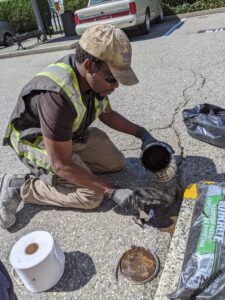
Balcony drains are a critical and frequently overlooked component. Debris clogs reduce drainage efficiency and allow water to pond on the surface, accelerating membrane deterioration. More significantly, the connection between the drain body and the waterproofing membrane is a common failure point — if the drain flange seal fails, water bypasses the membrane entirely. Drains should be cleaned at least twice a year and inspected for proper seating and seal integrity. During a full balcony restoration, drain replacement is usually recommended regardless of apparent condition — the labour cost of replacing drains later far exceeds the material cost of doing it during restoration.
Railing Anchor Corrosion
Balcony railings are typically attached to the slab through steel anchor bolts or post bases. These penetrations through the waterproofing membrane are sealed, but the seals deteriorate over time. Moisture then reaches the anchors, which corrode and expand — cracking the surrounding concrete and compromising the railing’s structural integrity. This is both a waterproofing problem and a life-safety issue. Corroded railing anchors are a building official concern and a WorkSafeBC liability issue. If your building has older railing systems with visible rust staining around the post bases, this warrants immediate professional assessment. Balcony railings must meet current BC Building Code requirements for height and load resistance, and corroded anchors may not meet these standards regardless of how the railing itself appears.
Concrete Deterioration
Once water penetrates the membrane, the structural concrete of the balcony slab begins to deteriorate. Rebar corrodes and expands, causing spalling and delamination. The slab edges — exposed on three sides to the weather — are particularly vulnerable. Concrete deterioration must be addressed as part of any comprehensive balcony restoration. Patching over damaged concrete without treating the underlying steel is a short-term solution that will fail again within a few years.
The Balcony Restoration Process
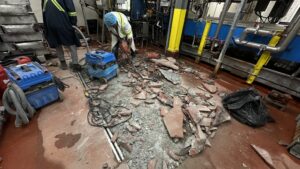
A full balcony restoration typically follows these steps: First, a contractor or engineer inspects the balcony to determine the condition of the membrane, concrete, drains, and railing anchors. Next, existing finishes and the failed waterproofing membrane are removed, and all deteriorated concrete is broken out. Corroded rebar is treated or replaced, concrete voids are repaired with appropriate mortars, and railing anchor hardware is assessed and replaced as needed. A new waterproofing membrane is then installed with careful attention to all transitions, drains, wall-to-deck junctions, door thresholds, and railing penetrations. The new membrane is protected with a tile system, traffic coating, or pavers depending on the building design and strata bylaws. Finally, the system is allowed to cure, flood-tested where possible, and inspected before the balcony is returned to use.
Strata vs. Owner Responsibility in BC
The question of who pays for balcony restoration depends on your strata’s bylaws and BC strata legislation. As a general rule under the Strata Property Act, the balcony slab itself is common property, making the strata responsible for structural repairs, waterproofing, and anything that affects the building envelope. The finish surface (tile, pavers) inside the strata lot may be the owner’s responsibility depending on bylaws. The railing system attached to common property is typically a strata responsibility. Many disputes arise over balcony responsibility — we strongly recommend that strata councils obtain a legal opinion or consult with a strata management professional when the responsibility boundary is unclear. What is consistent across virtually all interpretations is that structural balcony repairs — including waterproofing and concrete work — are a strata responsibility. Planning a building-wide balcony restoration program is almost always more cost-effective than piecemeal repairs, and allows for unified design standards across the building.
Ready to Protect Your Property?
Miyagi Construction Ltd. has been serving property managers, strata councils, and commercial building owners across the Vancouver Lower Mainland for years. Contact us today for a free on-site estimate:
📞 778-513-7471
✉️ estimate@miyagiconstruction.com
We serve Burnaby, Vancouver, Surrey, Richmond, Coquitlam, New Westminster, and the entire Lower Mainland.
Related Services: Learn more about our balcony and concrete restoration, waterproofing membrane systems — or contact us at estimate@miyagiconstruction.com to request a free site assessment.
Additional Resources
For more information on concrete standards and construction safety in British Columbia, visit BC Construction Safety Alliance and the CSA Group for industry standards and guidelines.
Get a Free On-Site Assessment
Tell us about your project and we'll get back to you within 24 hours. No obligation, no pressure.