Water damage to a balcony can progress significantly before it becomes obvious — by the time you see rust staining on the ceiling of the unit below or chunks of concrete falling from the balcony soffit, the damage has been developing for years. Knowing the early warning signs of balcony water damage allows strata councils, property managers, and individual owners to intervene before the problem becomes a major structural repair.
Early Warning Signs You Can See From the Balcony
Start by looking at the balcony surface itself. Bubbling or lifting of the waterproofing membrane or finish coating is a clear sign that water has infiltrated beneath the surface layer, either through a crack or a failed seam. Soft spots under tile or pavers — detectable by gently pressing on them — indicate that the bond to the substrate has been lost due to moisture under the finish. Cracks in the concrete substrate visible through or around the finish material indicate structural movement or deterioration.
At the perimeter, look carefully at the joint between the balcony surface and the wall or railing post base — these transitions are common failure points where water enters. Rust staining on the wall face below railing post base plates indicates corrosion of the embedded anchor hardware, suggesting that moisture has been penetrating around the post base for some time. See our concrete repair services for structural damage assessment.
Signs Visible From Below or Adjacent
Some of the clearest water damage indicators are visible not on the balcony itself but on the unit below. Efflorescence (white chalky deposits) on the ceiling or soffit below a balcony indicates that water is migrating through the concrete and depositing minerals as it evaporates. Dark staining or water marks on the soffit ceiling indicate active or historic water intrusion. Rust staining — orange or brown streaks running from a point on the soffit outward — is a definitive sign of rebar corrosion driven by moisture infiltration from above.
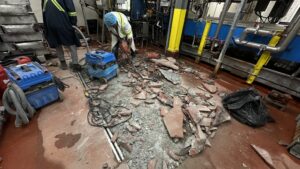
Spalling concrete — where chunks of the soffit have detached or are visibly loose — is a serious condition requiring urgent attention. Loose concrete in an overhead position poses a safety risk, and the underlying corrosion that caused it has likely been progressing for years. Our team provides emergency assessment and stabilization for spalling balcony soffits throughout Metro Vancouver.
What to Do If You Identify Water Damage Signs
If you observe any of these warning signs — on your own balcony or on a common property balcony as part of your strata council responsibilities — the appropriate first step is a professional condition assessment by a qualified concrete and waterproofing contractor. The assessment will determine the extent of the damage, the cause, and the required repair scope. Early identification and repair is almost always significantly less expensive than waiting for the damage to progress. Visit our waterproofing services page and our FAQ for more on balcony water damage assessment and repair.
Contact Miyagi Construction for a free site assessment at estimate@miyagiconstruction.com or call (778) 513-7471.
Additional Resources
For more information on concrete standards and construction safety in British Columbia, visit BC Construction Safety Alliance and the CSA Group for industry standards and guidelines.
Get a Free On-Site Assessment
Tell us about your project and we'll get back to you within 24 hours. No obligation, no pressure.