Inspecting and assessing the condition of post-tension cables in an existing concrete structure is one of the more technically challenging tasks in building maintenance. Unlike conventional rebar, which can be inspected after removing the surrounding concrete, post-tension tendons are enclosed in plastic sheathing within the slab and are not directly accessible without significant intervention. Understanding the inspection methods available — and their capabilities and limitations — helps building owners make informed decisions about PT maintenance and repair.
Visual Inspection of Anchor Heads and Slab Surface
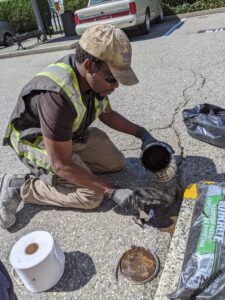
The most accessible and lowest-cost form of PT inspection is thorough visual inspection of all anchor heads, anchor pockets, and slab surfaces. Anchor pocket covers should be removed and the anchor hardware inspected for corrosion, strand protrusion (indicating slip), or concrete cracking around the anchor zone. Slab surfaces are inspected for crack patterns that might indicate PT distress — banded cracking perpendicular to tendon direction, unusual deflection patterns, or spalling adjacent to tendons.
Visual inspection alone cannot assess the condition of the tendon body within the slab, but it is a valuable first filter for identifying buildings that require more detailed investigation. Our PT assessment team includes visual anchor inspection as the foundation of every PT evaluation.
Non-Destructive Testing Methods
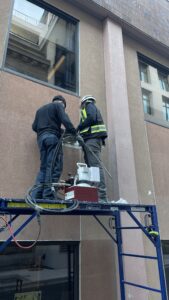
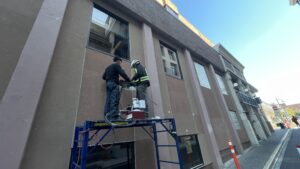
Several non-destructive testing (NDT) methods have been developed for post-tension condition assessment, though all have limitations in fully characterizing tendon condition through concrete cover. Ground-penetrating radar (GPR) can locate tendons within the slab and identify areas of sheathing discontinuity or metal loss — though it cannot directly detect wire failures within the strand. Magnetic methods (flux leakage or magnetic tomography) can detect wire breaks and cross-sectional area loss in steel tendons, but require specialized equipment and expertise. Impact-echo and ultrasonic testing can detect voids in grouted PT ducts in bonded systems.
For unbonded systems (by far the most common in Metro Vancouver), the most reliable NDT method for detecting wire failures is magnetic tomography performed by specialist contractors with dedicated post-tension wire-break detection equipment.
Selective Destructive Investigation
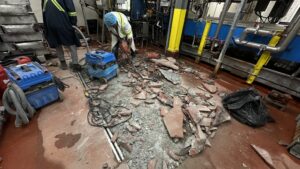
Where non-destructive methods are insufficient to characterize tendon condition adequately, selective destructive investigation — opening the slab or slab edge at specific locations to directly expose and examine the tendon — may be warranted. This approach is used when anchor head inspection reveals concerning corrosion patterns, when NDT results are inconclusive, or when planning a repair that requires knowing the condition of specific tendons.
Destructive investigation requires careful structural engineering oversight to ensure that opening the slab does not compromise the tendon or the structure. See our concrete repair services for related structural investigation work and our FAQ for guidance on PT inspection protocols in Metro Vancouver buildings.
Contact Miyagi Construction for a free site assessment at estimate@miyagiconstruction.com or call (778) 513-7471.
Additional Resources
For more information on concrete standards and construction safety in British Columbia, visit National Research Council Canada and the CSA Group for industry standards and guidelines.
Get a Free On-Site Assessment
Tell us about your project and we'll get back to you within 24 hours. No obligation, no pressure.