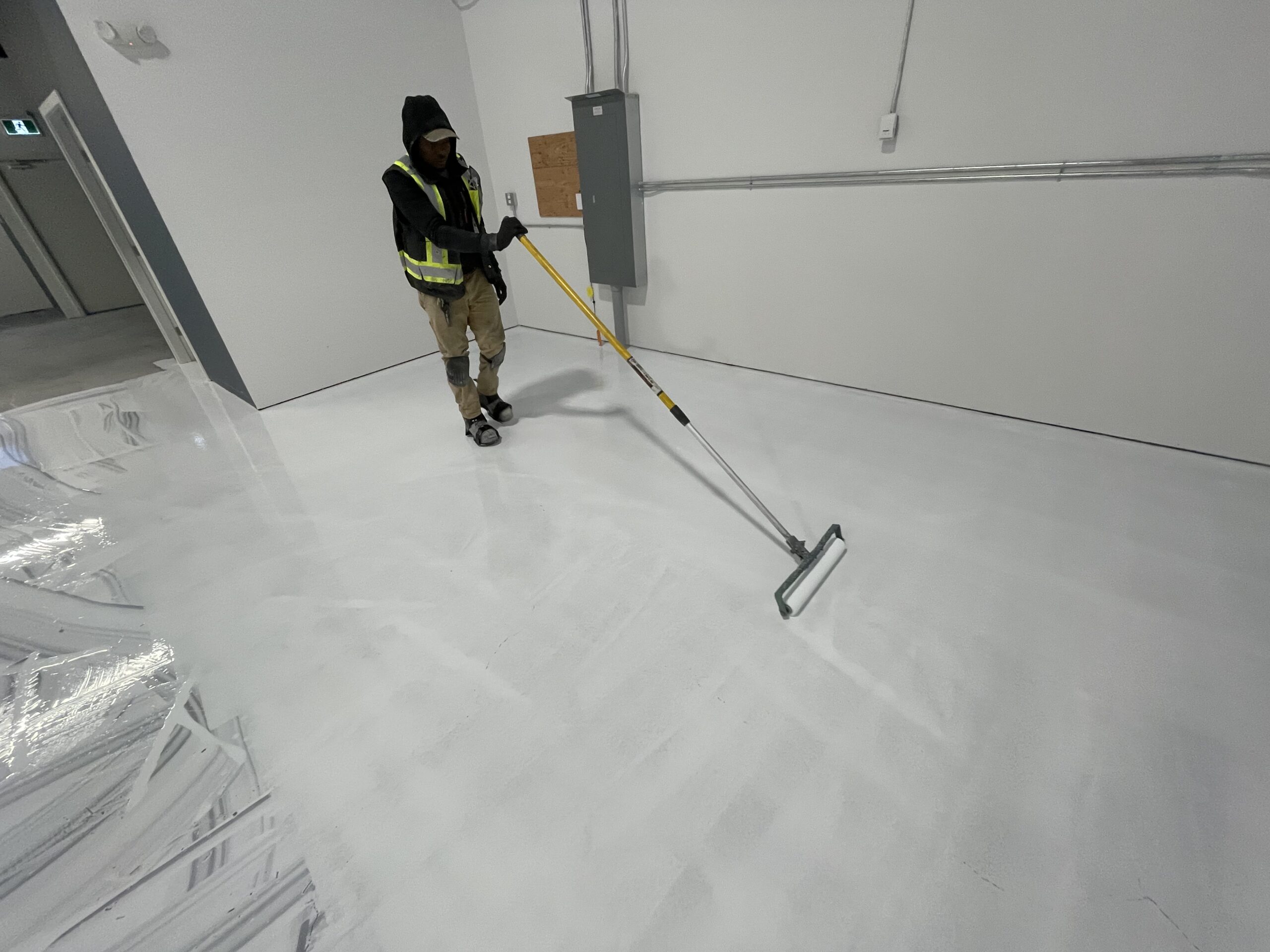
Surface preparation is the most critical determinant of epoxy floor coating performance — and the step most frequently compromised when cost pressure leads shortcuts. An epoxy coating applied to an improperly prepared concrete floor will delaminate, regardless of how high-quality the coating material is. Understanding what proper preparation involves — and why each step matters — helps building owners and project managers ensure their coating investment is protected.
Mechanical Surface Preparation: Creating the Right Profile
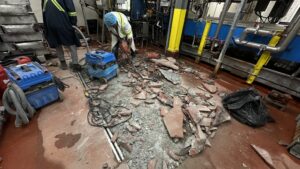
Epoxy coatings require a mechanically prepared concrete surface with a specific surface profile (CSP) to achieve adequate adhesion. The required profile depends on the coating system thickness and type, but most epoxy basecoat systems require a CSP of 3–4 — equivalent to a moderately rough, open texture that allows the epoxy to mechanically interlock with the concrete surface.
The two primary methods for achieving this profile are diamond grinding and shot blasting. Diamond grinding uses rotating diamond segments to abrade the surface and is appropriate for most commercial floor applications. Shot blasting propels steel shot at the surface at high velocity and provides an excellent, uniform profile with efficient coverage of large areas — it is the preferred method for industrial floor coating preparation. Acid etching (using muriatic acid) is sometimes used as a lower-cost alternative, but it is generally inadequate for high-build epoxy systems and creates hazardous waste that requires proper disposal. Our floor coating team uses diamond grinding and shot blasting for all professional projects.
Moisture Testing: A Critical Step Often Skipped
Moisture in concrete is the enemy of epoxy adhesion. Solvent-borne and water-borne epoxy systems are most sensitive, but even 100% solids epoxy can be compromised by excessive moisture vapor transmission from below the slab. Before any coating application, moisture content should be tested using ASTM F2170 (in-situ relative humidity probe) or ASTM F1869 (calcium chloride test). If moisture vapor emission rates exceed the coating manufacturer’s limit, the cause must be investigated and remediated before coating.
Moisture problems in Vancouver commercial floors often result from inadequate or missing under-slab vapor barriers, elevated water tables, or drainage issues around the building perimeter. Our team always conducts moisture testing before coating specification and installation.
Crack and Joint Repair Before Coating
All cracks and deteriorated floor joints should be repaired before epoxy coating application. Active cracks (still moving) should be routed and filled with a semi-rigid polyurethane joint filler to accommodate continued movement without transmitting stress to the coating. Dormant cracks can be filled with rigid epoxy crack filler. Deteriorated saw-cut control joints should be cleaned, inspected, and refilled with appropriate semi-rigid joint filler before coating. See our concrete repair services for floor crack and joint repair, and check our FAQ for more on floor coating preparation standards.
Contact Miyagi Construction for a free site assessment at estimate@miyagiconstruction.com or call (778) 513-7471.
Additional Resources
For more information on concrete standards and construction safety in British Columbia, visit CSA Group and the WorkSafeBC for industry standards and guidelines.
Get a Free On-Site Assessment
Tell us about your project and we'll get back to you within 24 hours. No obligation, no pressure.