Chloride-induced corrosion is the most aggressive form of rebar corrosion in parkade structures, and it is the dominant durability challenge in Metro Vancouver’s coastal environment. Understanding how chloride ions penetrate concrete, initiate corrosion, and cause structural deterioration is essential for property owners and strata councils who want to make informed decisions about parkade maintenance and repair.
How Chloride Ions Attack Concrete and Steel
Chloride ions enter concrete through two primary mechanisms in Metro Vancouver parkades: deicing salt application and marine airborne salts. Deicing salts (typically sodium chloride or calcium chloride) are applied to parkade ramps and entry areas during winter conditions and are then tracked throughout the structure by vehicle tires. Marine airborne salts are carried inland from Burrard Inlet and the Pacific Ocean, depositing on concrete surfaces where they are then washed in by rainfall or directly absorbed.
Once inside the concrete, chloride ions migrate toward the rebar through a diffusion process driven by concentration gradients. When the chloride concentration at the rebar depth exceeds a critical threshold (typically 0.4–0.6% by weight of cement), the passive oxide layer protecting the steel is disrupted, and active corrosion begins. Chloride-induced corrosion is particularly aggressive because it is pitting in nature — creating localized, deep corrosion that reduces rebar cross-section more quickly than the more uniform carbonation-induced corrosion.
Detecting Chloride Corrosion in Vancouver Parkades
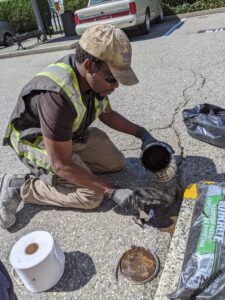
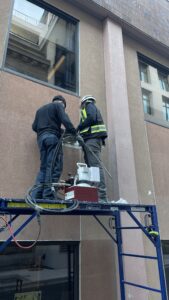
Chloride content in concrete is assessed by extracting core samples and conducting laboratory testing for water-soluble or acid-soluble chloride. The results are expressed as a percentage by weight of cement or concrete, and compared to the critical threshold for corrosion initiation. Half-cell potential mapping is also used to assess the probability of active corrosion across a structure — areas with highly negative half-cell potential readings indicate likely active corrosion even before visible damage appears.
These diagnostic methods are far more reliable than visual inspection alone for identifying chloride-induced corrosion, since the damage often progresses significantly below the concrete surface before becoming visible. Our concrete repair assessments include chloride testing where the building’s history and location suggest it is a factor.
Repair and Prevention Strategies
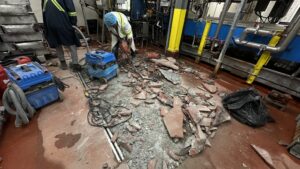
Repairing chloride-induced corrosion damage requires removing all concrete with chloride levels above the corrosion threshold — not just the visibly damaged areas. Leaving chloride-contaminated concrete adjacent to a repair creates a galvanic cell that accelerates corrosion in the repair perimeter, a phenomenon known as the halo or ring anode effect.
Prevention focuses on maintaining a robust waterproofing membrane that prevents chloride-laden water from reaching the concrete, and applying penetrating sealers to concrete surfaces not covered by the membrane. In severe cases, cathodic protection systems can be installed to arrest ongoing corrosion electrochemically. Our parkade waterproofing services form the first line of defense against chloride ingress. Visit our FAQ for more on chloride testing and repair planning.
Contact Miyagi Construction for a free site assessment at estimate@miyagiconstruction.com or call (778) 513-7471.
Additional Resources
For more information on concrete standards and construction safety in British Columbia, visit WorkSafeBC and the CSA Group for industry standards and guidelines.
Get a Free On-Site Assessment
Tell us about your project and we'll get back to you within 24 hours. No obligation, no pressure.