Parkade structures are among the most stressed components in any multi-unit residential or commercial building. They carry vehicle loads, resist water infiltration, and hold up conditioned occupied space below — all while being exposed to deicing chemicals, freeze-thaw cycles, and traffic vibration year after year. Like any heavily used structure, parkades give warnings before serious problems develop. The challenge is knowing which warning signs require immediate action and which can be monitored over time. Here are five signs that your parkade needs immediate professional attention — not something to put on the list for next year.
1. Active Water Infiltration and Water Staining
Water staining on the underside of a parkade deck — the soffit that forms the ceiling of the level below — is a reliable indicator of waterproofing failure above. Fresh staining shows that water is currently moving through the slab. Old, dried staining with efflorescence (white mineral deposits) shows that water has been infiltrating for some time and that dissolved minerals have been leached from the concrete matrix. Active drips or puddles on the parkade floor are more urgent: they indicate significant waterproofing failure and mean that structural concrete is being continuously wetted, accelerating deterioration. Water infiltrating through an above-grade parkade deck also often means water is infiltrating any occupied space below — whether that is a unit, a retail space, or a mechanical room. The urgency here comes from the cumulative nature of water damage. Every month of continued infiltration adds to the repair cost. A small leak that costs $15,000 to remediate today might cost $80,000 after two more years of progressive membrane and concrete deterioration.
2. Rust Streaks on Concrete Surfaces
Rust-colored staining running vertically down walls, across soffits, or around column bases is one of the most significant warning signs in any concrete structure. It tells you that embedded steel (either conventional rebar or post-tension cables) is actively corroding and the corrosion products are leaching through the concrete to the surface. The critical issue is what is happening beneath the surface. Corrosion causes steel to expand significantly — sometimes to four times its original volume — and this expansion cracks and spalls the surrounding concrete. The surface staining you see is the visible tip of a much larger problem developing inside the structural element. Rust staining near post-tension cable anchors (the recessed pockets at slab edges) is a particularly critical finding, as it may indicate cable or anchor hardware corrosion with associated structural implications. This requires immediate assessment by a structural engineer.
3. Delamination (Hollow-Sounding Concrete)
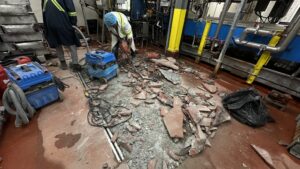
Tap on concrete surfaces with a hammer — if you hear a hollow, drum-like sound rather than a solid thud, the concrete has delaminated. Delamination means that a layer of concrete has separated from the underlying structure, typically because of a plane of weakness caused by corrosion, freeze-thaw damage, or poor bond between concrete layers. Delaminated concrete on overhead surfaces — parkade soffits, balcony undersides, beam soffits — is a safety emergency. Delaminated sections can fall without warning, and the weight of even a small piece of concrete falling several meters is sufficient to cause serious injury. If you identify significant hollow-sounding areas on overhead surfaces, the area below should be secured and access restricted until a qualified contractor can assess the risk and implement temporary protection. A systematic hammer-sounding survey of a parkade is a standard component of condition assessment and should be conducted on a regular basis — particularly in older buildings.
4. Pothole Formation in the Traffic Surface
Potholes in a parkade floor are more than a nuisance — they signal significant deterioration of the traffic coating, waterproofing membrane, and potentially the structural concrete beneath. In a properly functioning parkade, the traffic coating protects the waterproofing membrane below. When the coating fails and potholes form, vehicle traffic begins to directly contact the membrane, rapidly destroying it and allowing water to reach the structural slab. Small surface-level potholes limited to the traffic coating can be repaired relatively inexpensively. But potholes that have progressed into the waterproofing membrane or the structural concrete require much more extensive intervention, including membrane repair or replacement in the affected areas. The longer pothole damage is left unaddressed, the deeper the damage progresses and the more expensive the repair. Regular sweeping and cleaning of the parkade floor helps identify developing potholes early — any pothole, depression, or soft spot in the traffic surface should be inspected promptly.
5. Structural Cracks
Not all cracks in concrete are structural concerns — surface crazing and minor shrinkage cracks are common and generally benign. But certain types of cracks in parkade structures require immediate engineering assessment. Diagonal cracks at column-slab connections can indicate punching shear distress — a potentially catastrophic failure mode — and must be assessed by a structural engineer immediately. Cracks wider than 0.3mm allow direct water and chloride infiltration to reach reinforcing steel, indicating that the concrete is under significant stress. Use crack monitors to track whether cracks are static or widening — growing cracks indicate ongoing structural movement or loading issues that require investigation. Horizontal cracking in parkade retaining walls can indicate lateral earth pressure exceeding the wall’s design capacity. When in doubt about the significance of cracking, err on the side of having it assessed. A structural engineer can typically determine the nature and severity of cracking in a site visit, and the cost of that assessment is insignificant compared to the cost of a structural failure. The most expensive parkade repairs are the ones that were deferred too long. The most dangerous situations arise from warning signs that were dismissed as cosmetic.
Ready to Protect Your Property?
Miyagi Construction Ltd. has been serving property managers, strata councils, and commercial building owners across the Vancouver Lower Mainland for years. Contact us today for a free on-site estimate:
📞 778-513-7471
✉️ estimate@miyagiconstruction.com
We serve Burnaby, Vancouver, Surrey, Richmond, Coquitlam, New Westminster, and the entire Lower Mainland.
Related Services: Learn more about our parkade resurfacing and waterproofing, concrete repair — or contact us at estimate@miyagiconstruction.com to request a free site assessment.
Additional Resources
For more information on concrete standards and construction safety in British Columbia, visit WorkSafeBC and the CSA Group for industry standards and guidelines.
Get a Free On-Site Assessment
Tell us about your project and we'll get back to you within 24 hours. No obligation, no pressure.