When it comes to finishing concrete floors in a parkade, warehouse, or commercial space, two options come up most frequently: polished concrete and epoxy coating systems. Both can produce attractive, durable, and functional floors — but they perform very differently and suit different applications. Choosing the right system for your facility will affect durability, maintenance requirements, long-term cost, and the day-to-day experience of the people using the space. Here is an objective breakdown to help property managers and strata councils make an informed decision.
What Is Polished Concrete?
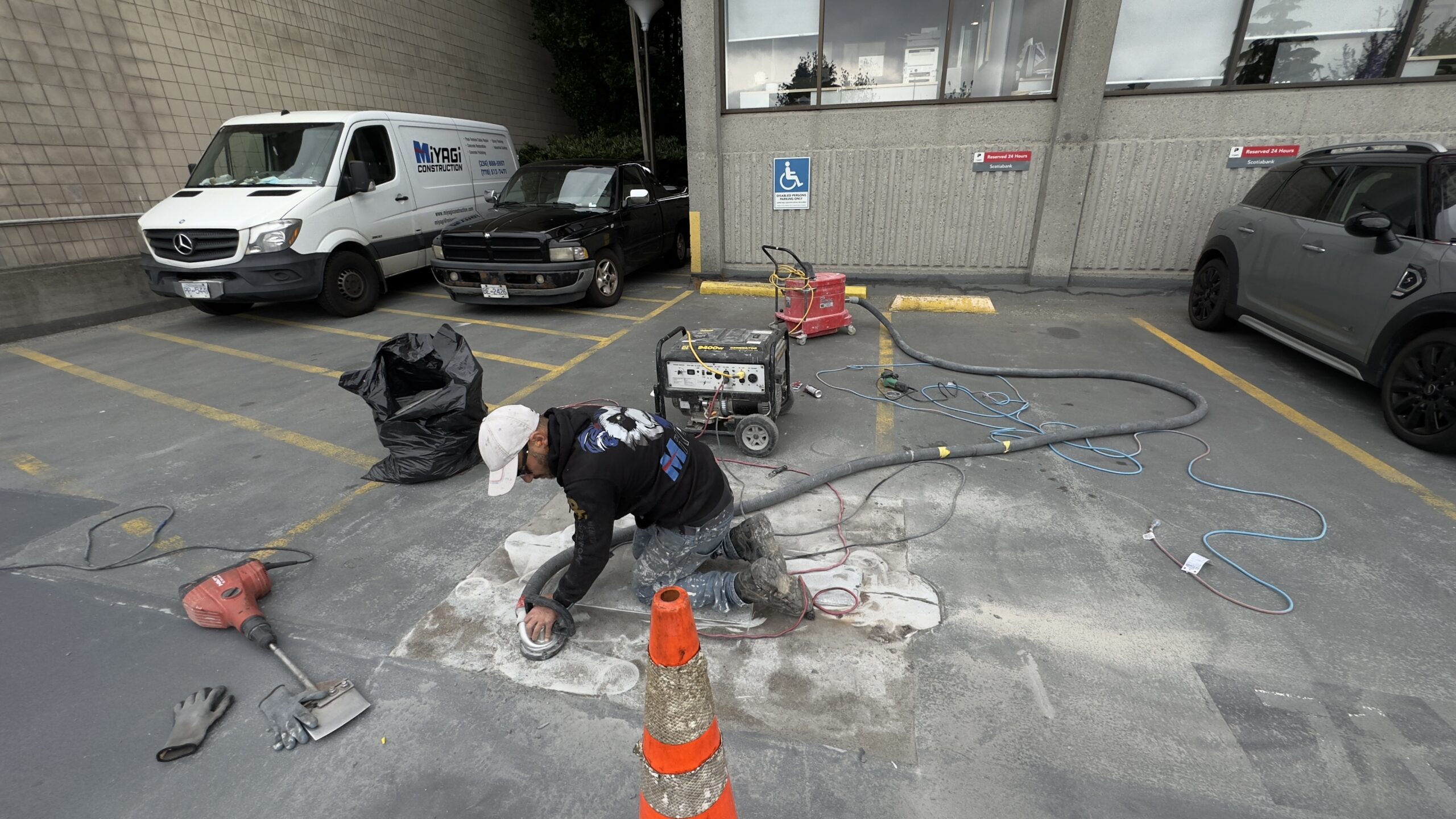
Polished concrete is achieved through a multi-step grinding and polishing process using progressively finer diamond abrasive tooling to refine the concrete surface to the desired level of sheen — from a matte, low-sheen finish to a high-gloss, mirror-like surface. The process also typically includes densifier treatment (which hardens and seals the concrete matrix) and a final sealer or guard application to improve stain resistance. Polished concrete is not a coating — it is a refinement of the existing concrete surface. This distinction matters: polished concrete cannot delaminate, peel, or be undermined by moisture from below the way coatings can.
What Is Epoxy Coating?
Epoxy coatings are two-component systems — a resin and a hardener — that when mixed and applied cure to form a hard, dense, plastic-like film bonded to the concrete substrate. There are many types of epoxy systems ranging from thin-film coatings (1–3 mils dry film thickness) to high-build coatings (10 mils or more) to mortar systems used to resurface damaged or uneven floors. Epoxy coatings can incorporate decorative elements like colored flakes or quartz aggregate broadcasts, and are often finished with a polyurethane or polyaspartic topcoat for UV stability and scratch resistance.
Durability Comparison
Polished Concrete
When properly executed, polished concrete is extremely durable. The densification process hardens the surface and significantly increases abrasion resistance. High-traffic areas — including vehicle traffic in parkades — are well-suited to polished concrete, provided the underlying slab is in sound condition. Polished concrete will not peel, chip, or delaminate. Maintenance is generally limited to periodic reapplication of the protective guard sealer. That said, polished concrete is not chemically resistant — oil, grease, and automotive fluids will stain the surface if not cleaned up promptly.
Epoxy Coatings
High-quality epoxy systems provide excellent chemical resistance — far superior to polished concrete — making them well-suited to environments with oil, fuel, and chemical exposure. A properly installed, high-build epoxy or epoxy mortar system is highly abrasion-resistant and can withstand heavy forklift and vehicle traffic when specified correctly. The vulnerability of epoxy systems is their adhesion to the substrate. If surface preparation is inadequate, or if moisture is present in the slab, epoxy coatings will delaminate over time. Moisture vapor transmission from below-grade slabs is a particularly common failure mechanism in Vancouver, where high ground moisture is prevalent.
Maintenance Requirements
Polished concrete requires regular damp mopping or auto-scrubbing to remove surface debris, and reapplication of the guard sealer every 1–3 years maintains the finish and stain resistance. Periodic re-polishing may be needed in very high-traffic areas after 5–10 years. Epoxy-coated floors are also easy to clean, particularly given their chemical resistance. However, they require attention to the topcoat condition — when the topcoat wears through, the underlying epoxy becomes more vulnerable. Maintaining the topcoat through periodic recoating extends system life significantly.
Cost Comparison
- Polished concrete: $5–$18 per sq ft depending on finish level
- Standard epoxy coating: $4–$8 per sq ft for a basic 2-coat system
- High-build epoxy with broadcast and polyurethane topcoat: $8–$15 per sq ft
Over a 10-year horizon, polished concrete often has a lower lifecycle cost in high-traffic vehicle areas because it requires no full floor recoating — only periodic guard reapplication. Epoxy systems in high-traffic zones may require topcoat reapplication every 3–5 years.
Which System Is Right for Your Space?
Choose polished concrete when the slab is in good condition with no significant moisture issues, the primary use is vehicle traffic, low long-term maintenance is a priority, the space has some natural light exposure, or you prefer a natural industrial aesthetic. Choose epoxy coating when chemical and oil resistance is critical, you need to resurface a rough or damaged slab, color-coded zones or safety markings are required, the space is fully enclosed with no UV exposure, or budget constraints favor a lower initial cost over lifecycle cost.
For most Vancouver parkades, a quality polyurethane traffic coating system applied over a properly installed waterproofing membrane is the most common and appropriate solution — combining waterproofing protection with a durable, slip-resistant wearing surface. The choice between polished concrete and epoxy typically comes up more in commercial, retail, and warehouse applications. The most important factor in the success of either system is surface preparation — diamond grinding or shot blasting to proper ICRI standards, moisture testing, and crack repair before application are not optional steps.
Ready to Protect Your Property?
Miyagi Construction Ltd. has been serving property managers, strata councils, and commercial building owners across the Vancouver Lower Mainland for years. Contact us today for a free on-site estimate:
📞 778-513-7471
✉️ estimate@miyagiconstruction.com
We serve Burnaby, Vancouver, Surrey, Richmond, Coquitlam, New Westminster, and the entire Lower Mainland.
Related Services: Learn more about our concrete polishing, industrial floor coating — or contact us at estimate@miyagiconstruction.com to request a free site assessment.
Additional Resources
For more information on concrete standards and construction safety in British Columbia, visit WorkSafeBC and the CSA Group for industry standards and guidelines.
Get a Free On-Site Assessment
Tell us about your project and we'll get back to you within 24 hours. No obligation, no pressure.