Post-tensioned concrete is found throughout Vancouver’s residential and commercial buildings — particularly in parkade decks, podium slabs, and high-rise floor plates built from the 1970s onward. It is a highly efficient structural system that allows thinner slabs and longer spans than conventional reinforced concrete. But when post-tension cables begin to fail, the consequences can be serious — and the warning signs are often visible well before structural failure occurs. If you manage a strata building or commercial property with a post-tensioned structure, understanding these warning signs could prevent a dangerous situation and save significant repair costs.
What Are Post-Tension Cables?
Post-tensioning is a method of reinforcing concrete using high-strength steel cables (called tendons or strands) that are tensioned after the concrete has been poured and cured. The tendons are housed in plastic or metal sheaths embedded in the concrete. After curing, hydraulic jacks stretch the tendons to very high tension levels — typically 33,000 to 40,000 lbs per cable — and then they are anchored at each end using metal wedge anchors. The tensioned cables put the concrete into compression, dramatically increasing its load-bearing capacity and crack resistance. This system works beautifully when properly installed and maintained. The problem arises when moisture or chlorides penetrate the protective system around the tendons, initiating corrosion. Because the cables are under extreme tension, even a small amount of corrosion can cause sudden, brittle failure.
Warning Signs of Post-Tension Cable Problems
Rust Staining and Water Infiltration
One of the earliest visible signs of tendon distress is rust staining — brown or orange streaks running across concrete surfaces, often in linear patterns that follow the cable layout. You may see staining on the soffit of a parkade deck, on balcony edges, or on the sides of beams. Linear patterns at consistent intervals matching the tendon spacing are a strong indicator. Water infiltration at anchor pockets — the recesses at the edges of slabs where tendons are anchored — is also a critical sign. These pockets are often filled with grout after tensioning, but if the grout cracks or was not properly applied, moisture can reach the highly stressed anchor components directly.
Popped or Broken Tendons
When a post-tension tendon fails completely, the energy release is dramatic. The tendon snaps and the broken ends may punch through the concrete, creating a visible hole or crack at the anchor location. In some cases, the broken tendon retracts into the slab. You may hear a loud bang at the time of failure, or simply notice the aftermath — a hole in the concrete at the slab edge, or a crack running from an anchor pocket. A single broken tendon in a well-designed structure may not immediately compromise structural integrity, but it increases load on adjacent cables and accelerates deterioration. Multiple failures can be catastrophic.
Cracking Patterns
Post-tensioned slabs are designed to be nearly crack-free under normal conditions. The appearance of cracks — particularly diagonal cracks at column heads, longitudinal cracks at mid-span, or cracks radiating from anchor locations — indicates that the prestress force is no longer functioning as designed. These cracks require immediate professional assessment. It is important to distinguish post-tension-related cracking from shrinkage cracks. Shrinkage cracks typically occur early in a building’s life, are relatively uniform, and do not grow. Cracks associated with tendon distress tend to appear in older structures, are often wider, and may continue to develop over time.
Delamination and Concrete Spalling at Slab Edges
The slab edge — the perimeter of a post-tensioned deck — is where tendons are anchored and where the system is most vulnerable to moisture ingress. Spalling, delamination, or breakout of concrete at slab edges — particularly if accompanied by rust staining — should be treated as a potential tendon distress indicator until proven otherwise.
Risks of Delaying Repair
The stakes with post-tension cable failures are higher than with conventional reinforcing. Because tendons are under thousands of pounds of tension, their failure can be sudden and unpredictable. The risks include progressive collapse — failure of one tendon increases stress on adjacent elements, potentially triggering a chain reaction. At column-slab connections, the combination of tendon loss and high concentrated loads can cause sudden punching shear failure. If a strata council is aware of post-tension distress and fails to act, the legal and financial consequences of a structural failure could be severe. Early-stage tendon corrosion can be addressed by protecting the existing system. Late-stage failures may require partial or complete slab replacement, which is exponentially more expensive.
The Repair Process
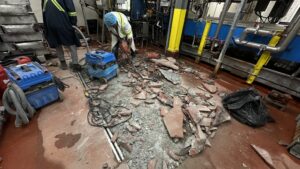
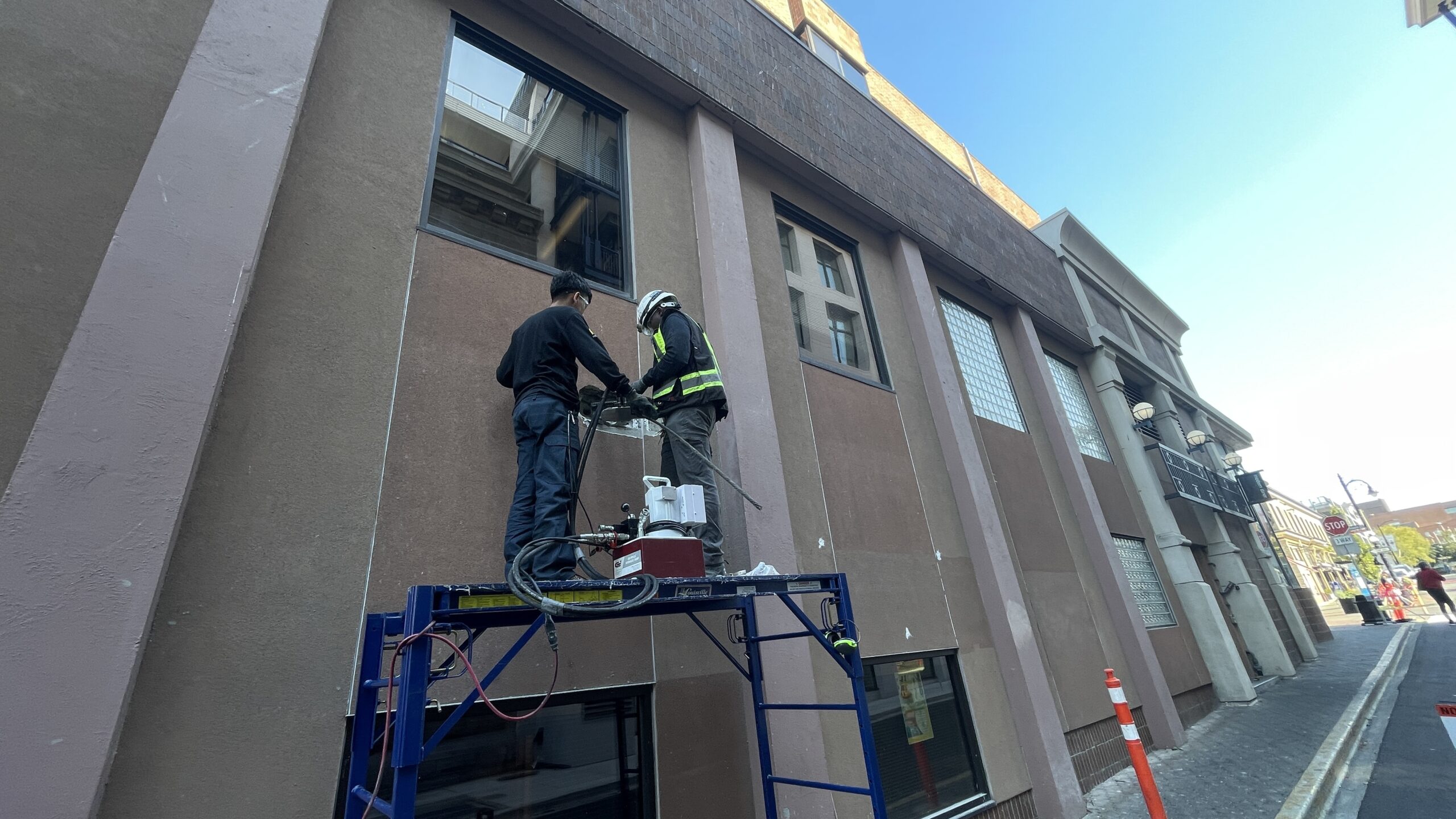
Post-tension cable repair is specialized work that requires both concrete repair expertise and understanding of structural behavior. The typical repair process includes a condition assessment by a structural engineer reviewing the building’s original post-tension drawings and conducting an on-site inspection — possibly including ground-penetrating radar to locate tendons. Corroded or damaged anchor hardware is removed, replaced, and the pocket is re-grouted with appropriate materials. Where tendons have failed, the engineer will specify either replacement or supplemental steel reinforcement to restore required capacity. Damaged concrete is removed, rebar and tendon sheaths are treated, and the concrete is replaced with high-performance repair mortars. Finally, a comprehensive waterproofing strategy is implemented to prevent future moisture ingress — addressing the root cause. This work typically requires a structural engineer of record, building permits, and careful coordination with residents or tenants.
Ready to Protect Your Property?
Miyagi Construction Ltd. has been serving property managers, strata councils, and commercial building owners across the Vancouver Lower Mainland for years. Whether you’re dealing with urgent structural concerns or planning proactive maintenance, our team provides honest assessments, quality workmanship, and lasting results.
Contact us today for a free on-site estimate:
📞 778-513-7471
✉️ estimate@miyagiconstruction.com
We serve Burnaby, Vancouver, Surrey, Richmond, Coquitlam, New Westminster, and the entire Lower Mainland.
Related Services: Learn more about our post-tension cable repair, structural concrete repair — or contact us at estimate@miyagiconstruction.com to request a free site assessment.
Additional Resources
For more information on concrete standards and construction safety in British Columbia, visit National Research Council Canada and the CSA Group for industry standards and guidelines.
Get a Free On-Site Assessment
Tell us about your project and we'll get back to you within 24 hours. No obligation, no pressure.